My story Notes on a ‘Masterpiece’ has been selected as the Willesden Herald Story of the Month for August. You can read it here.
How I Wrote ‘High-Intensity Interval Training’

(Photo by Sander Sammy on Unsplash)
Writers are often asked where they get their ideas from. Mostly that’s a difficult question to answer, but this story had a very definite moment of inspiration. It was conceived while doing a Joe Wicks workout in lockdown, which I think is the first time I’ve ever got anything truly satisfying out of exercise. Writing really is 90 per cent perspiration.
I love stories in which the structure complements, comments on and expands the theme and plot. With the HIIT workouts, I quickly realised that the different exercises could provide a workable structure. The ‘Warm Up’ and ‘Cool Down’ provided an obvious beginning and ending, and it was a short step from there to the idea that this could be about the course of a relationship.
Then it was a case of selecting the exercises that could be used as stepping stones in that relationship arc. Some lent themselves very quickly: I saw how I could use ‘Mountain Climbers’ and ‘Plank’ and ‘Butt Kicks’, but I knew I needed something more. That’s where the ‘Russian Twist’ came in.
My dad has never been keen to discuss his childhood and indeed appears to have forgotten almost every detail of his past. I’d picked up bits of information here and there. In particular, I believed that his grandparents were Russian Jews, who came over to England to escape the early twentieth-century pogroms in Russia. I asked him once if he knew anything about this and he said no, though he called his grandmother ‘Bushka’. It may be a stretch to definitively link this to the Russian word babushka, meaning ‘grandmother’, and I may never find out the truth, but it planted a seed that eventually provided a key theme in the story and made it about something deeper than merely keeping fit.
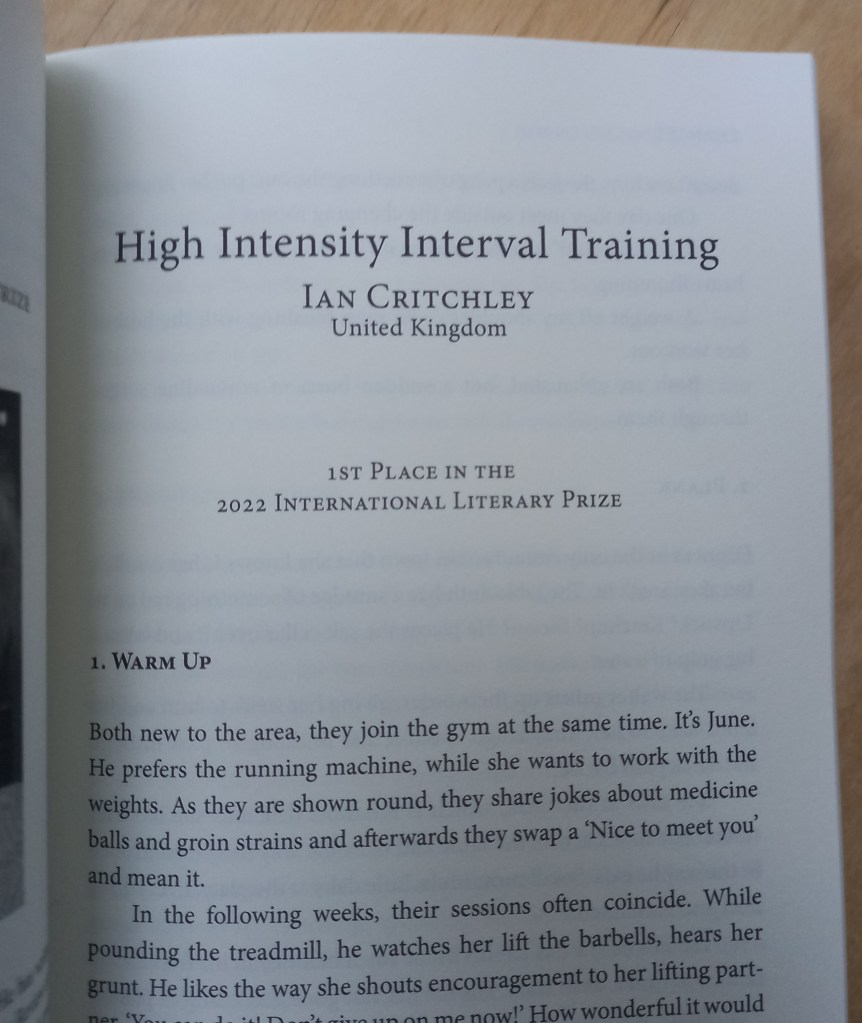
I knew the story worked, but was hesitant to send it out. It takes me so long to write a story that it often feels out of date by the time it’s finished. I didn’t know if anybody would want to read a story about lockdown workouts so long after the lockdowns were over. I was therefore stunned and delighted when the story won the Hammond House International Literary Prize.
You can read the story here (click on the down arrow on the right-hand side of that page to expand the text).
High-Intensity Interval Training
Very happy to say that my story ‘High-Intensity Interval Training’, which won the Hammond House International Literary Prize, can now be read online here. (Click on the down arrow on the right next to my name.)
Eastbound, Westbound

(Photo by Markus Spiske on Unsplash)
My short story ‘Eastbound, Westbound’ will be published in the new issue of the fabulous Lighthouse Journal. You can buy a copy here and if you’d like to hear me read from it, do come along to the online launch – free tickets can be booked here.
Upper Kutz

(Photo by André Reis on Unsplash)
New story alert! In ‘Upper Kutz’, a family drama plays out in a barber’s on Christmas Eve. Really proud of this story, which took several years to come to fruition, and especially pleased to have it published in Structo, one of my favourite literary magazines. You can read it here.
The First Writer-in-Residence on the Moon

Delighted that my story ‘The Final Front Ear’, about the first writer-in-residence on the moon, has been shortlisted for the Plaza Prize. See the full shortlist here.
Interview

I was interviewed at the 2023 Hammond House Literary Festival. View here
Prize winner!
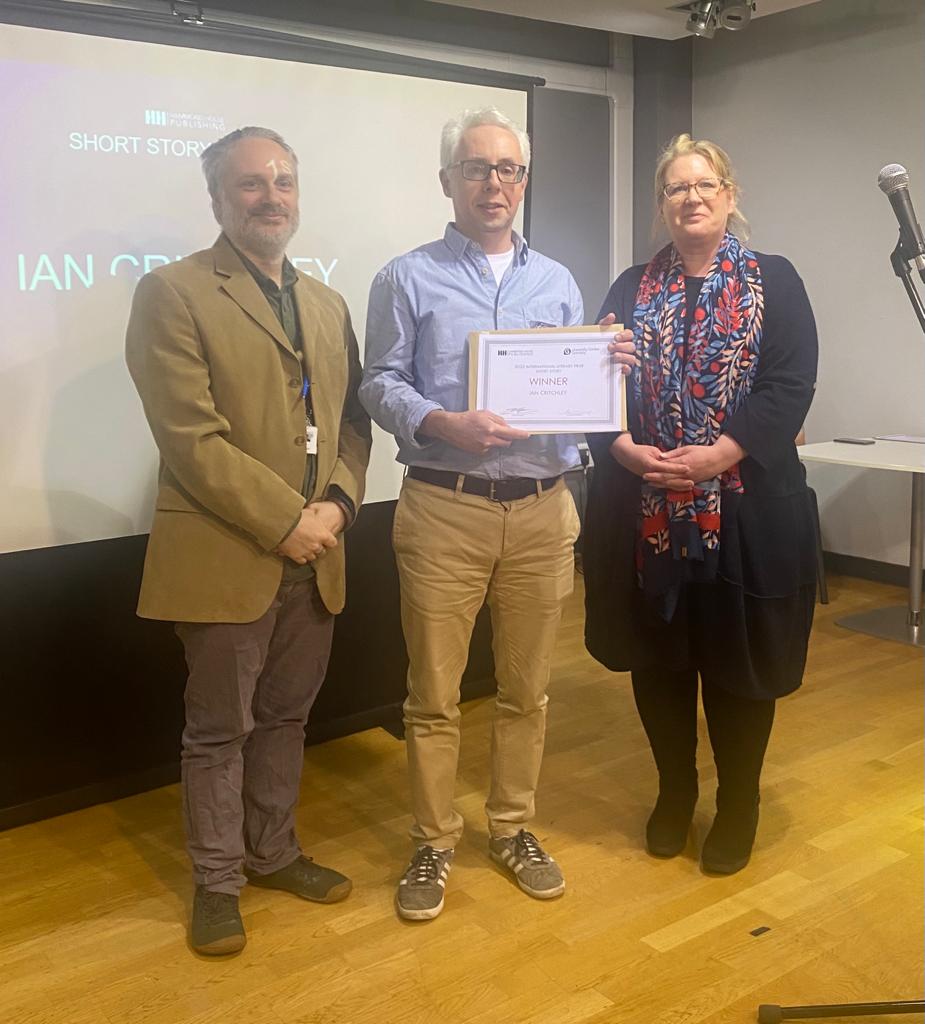
This week I had a grand day out at the Hammond House Literary Festival, where I picked up my award for winning the International Short Story Prize, plus a couple of copies of the anthology. So great to see the story in print.

Salman Rushdie’s new novel

Salman Rushdie’s exuberant but uneven new novel was completed before the horrific attack on him last year. I’ve reviewed it for the Literary Review here
Books of the Year 2022
(Photo by Ed Robertson on Unsplash)
After a bit of a fallow period for short story reading last year, I maxed out this year with some wonderful collections.

Reverse Engineering is a series of books from newbie publisher Scratch Books and is based on a simple but wonderful concept: a set of classic contemporary stories alternating with interviews with their authors about their craft. Writers such as Sarah Hall and Chris Power give invaluable insights into their writing process. The second book in the series is on my Christmas list.
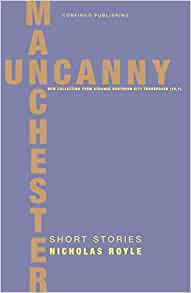
Nicholas Royle’s Manchester Uncanny (Confingo) is the second in a trilogy of collections exploring the mysterious and eerie corners of three cities (following London, and with Paris to come). Royle draws skilfully on Manchester’s geography and heritage, including a story based on Joy Division’s first album, Unknown Pleasures. A compelling collection.


I’ve long wanted to master the art of writing flash fiction but usually fail miserably. Nick Black’s collection of (mostly) flash pieces, Positive and Negative (AdHoc), is a terrific example of the genre. There was also a welcome new collection this year from Amanda Huggins – An Unfamiliar Landscape (Valley Press) features her excellent Colm Tóibín award-winning story ‘Eating Unobserved’. I also really enjoyed collections by Chloe Turner (Witches Sail in Eggshells, Reflex Press), Jamie Guiney (The Wooden Hill, époque) and Ben Pester (Am I in the Right Place?, Boiler House).


In non-fiction, there were three standout books. The Passengers by Will Ashon (Faber) is a remarkable work of contemporary oral history: Ashon interviewed dozens of people all around the UK, and their voices bear witness to what it means to be alive today. Michael Pedersen’s Boy Friends (Faber) is a lyrical and moving exploration of male friendship – a tribute to Scott Hutchison, the singer-songwriter who died in 2018.
For a number of years, the Times journalists Rachel Sylvester and Alice Thomson have jointly interviewed public figures. Their fascinating book, What I Wish I’d Known When I Was Young (William Collins) draws on these interviews to investigate how adversity in childhood can influence adult life.


Fiction-wise, I was greatly impressed by Ashley Hickson-Lovence’s Your Show (Faber), which tells the story of football referee Uriah Rennie. Set in Stone by Stela Brinzeanu (Legend) is a beautifully written tale of love against the odds, set in medieval Moldova but with contemporary resonances. Zoë Folbigg’s The Three Loves of Sebastian Cooper (Boldwood) is a page-turning story of three very different women as they gather at the funeral of the man they all loved.


I was hugely excited to learn that Louise Welsh was publishing a sequel to her brilliant novel The Cutting Room, and it didn’t disappoint. The Second Cut (Canongate) takes us back to the seedy Glasgow world of auctioneer Rilke in another superb literary thriller. Last but definitely not least, I loved Janice Hallett’s The Twyford Code (Viper), an ingenious crime novel told almost entirely through transcribed audio files.
 Ian Critchley